Overview and Mythological Origins
Hampi, situated along the banks of the Tungabhadra River in the Vijayanagara district of Karnataka, India, was the capital of the Vijayanagara Empire from 1336 to 1565.
Before its emergence as an imperial metropolis, the region was known as Pampa Kshetra, named after Pampa (an incarnation of Goddess Parvati) and her consort Virupaksha (Lord Shiva). In local tradition, Hampi is also identified with Kishkindha, the monkey kingdom featured in the Hindu epic Ramayana, where Lord Rama met Hanuman and Sugriva. Ashokan rock edicts discovered in the surrounding region confirm that the area held strategic and religious significance as early as the 3rd century BCE under the Maurya Empire, later coming under the influence of the Kadambas, Chalukyas, Rashtrakutas, and Hoysalas.
The Rise of the Vijayanagara Empire
- Founding (1336): The city of Vijayanagara ("City of Victory") was established by two brothers, Harihara I and Bukka Raya I, members of the Sangama dynasty. Guided by the spiritual counsel of sage Vidyaranya of the Sringeri Sharada Peetham, they united the fragmented southern kingdoms against the expansionist campaigns of northern sultanates.
- Capital Selection: Chosen for its defensible natural topography—flanked by rugged granite hills and the fast-flowing Tungabhadra River—Hampi rapidly expanded into one of the largest and wealthiest fortified cities of the medieval world.
- Dynastic Rule: The empire was governed sequentially by four distinct dynasties:
- Sangama Dynasty (1336–1485)
- Saluva Dynasty (1485–1505)
- Tuluva Dynasty (1491–1570)
- Aravidu Dynasty (1570–1646)
The Golden Age: Reign of Krishnadevaraya (1509–1529)
The peak of the empire occurred during the rule of Emperor Krishnadevaraya of the Tuluva dynasty:
- Military Dominance: Krishnadevaraya expanded the borders of the empire, subduing the Gajapatis of Odisha and asserting control over the Raichur Doab against the Sultanate of Bijapur.
- Flourishing Trade: Hampi became an international commercial hub. European and Middle Eastern travelers—including Portuguese chroniclers Domingo Paes and Fernão Nunes, and Persian ambassador Abdur Razzak—recorded that markets traded extensively in precious stones, diamonds, silks, spices, and high-quality cavalry horses from Arabia and Persia.
- Cultural and Architectural Renaissance: Krishnadevaraya was a noted patron of the arts, literature, and temple architecture. Under his patronage, the Dravidian architectural style reached new levels of sophistication, marked by grand gopurams (temple towers), expansive pillared halls (mandapas), and intricate stone carvings.
The Fall of Hampi: The Battle of Talikota (1565)
- Political Polarization: Under regent Aliya Rama Raya, Vijayanagara engaged in intricate diplomacy, playing rival Deccan Sultanates against one another. This strategy eventually unified the Deccan Sultanates (Bijapur, Golconda, Ahmadnagar, and Bidar) into a coordinated alliance.
- The Conflict: In January 1565, the imperial army met the allied Sultanate forces at the Battle of Talikota (also known as Rakkasagi-Tangadagi). Due to internal desertions and coordinated artillery tactics by the allied forces, Vijayanagara suffered a catastrophic defeat. Rama Raya was captured and executed.
- The Sack of Vijayanagara: The allied forces advanced to Hampi, looting, burning, and systematically demolishing its monuments, palaces, and civic infrastructure over several months. The royal court fled to Penukonda and later Chandragiri (under the Aravidu dynasty), but Hampi itself was largely abandoned and reduced to ruins.
Significant Historical Figures
- Harihara I & Bukka Raya I: Co-founders of the empire who established the fortified capital and established the administrative foundation of Vijayanagara.
- Sage Vidyaranya: Spiritual mentor whose guidance consolidated political and religious authority under the Sangama rulers.
- Krishnadevaraya: The most celebrated ruler of Vijayanagara; military strategist, author of the Telugu epic Amuktamalyada, and architectural patron.
- Aliya Rama Raya: Powerful statesman and de facto ruler during the mid-16th century whose political maneuvers led directly to the confrontation at Talikota.
- Domingo Paes & Fernão Nunes: Portuguese visitors whose written chronicles provide firsthand historical accounts of 16th-century life, court protocol, urban layout, and commerce in Hampi.
Important Landmarks
- Virupaksha Temple: One of the oldest surviving and continuously functioning temples in the region, dedicated to Lord Shiva. It features a towering 50-meter-high eastern gopuram, detailed relief carvings, and an ancient pinhole-camera effect in one of its inner chambers.
- Vijaya Vittala Temple: A masterwork of Vijayanagara architecture, famous for its stone chariot—a monolithic shrine dedicated to Garuda—and its large pillared hall containing pillars sculpted to produce tonal musical resonance when tapped.
- Lotus Mahal: Located within the Zenana Enclosure, this two-story pavilion demonstrates the integration of Hindu and Islamic architectural elements (Indo-Islamic style), characterized by recessed cusped arches and vaulted ceilings.
- Elephant Stables: An expansive structure featuring eleven domed chambers designed to house the imperial state elephants, reflecting strong secular and Sultanate architectural influences.
- Hazara Rama Temple: The private place of worship for the royal family, renowned for thousands of detailed bas-reliefs running along its exterior walls depicting scenes from the Ramayana.
- Lakshmi Narasimha (Ugra Narasimha) Monolith: A massive 6.7-meter-high monolithic statue carved from a single boulder in 1528, depicting Lord Narasimha seated in a yogic posture beneath a seven-hooded serpent.
- Badavilinga Temple: Situated adjacent to the Narasimha monolith, this massive 3-meter-high Shiva Linga is carved from black stone and remains permanently partially submerged in canal water.
- Queen’s Bath: An elaborate royal bathing pavilion featuring an open-to-sky central pool surrounded by vaulted corridors, balconies, and decorative stucco ornamentation.
- Matanga Hill: The highest geographical point in Hampi, offering panoramic views of the city's ruins, temples, and surrounding granite boulder fields.
Modern Status
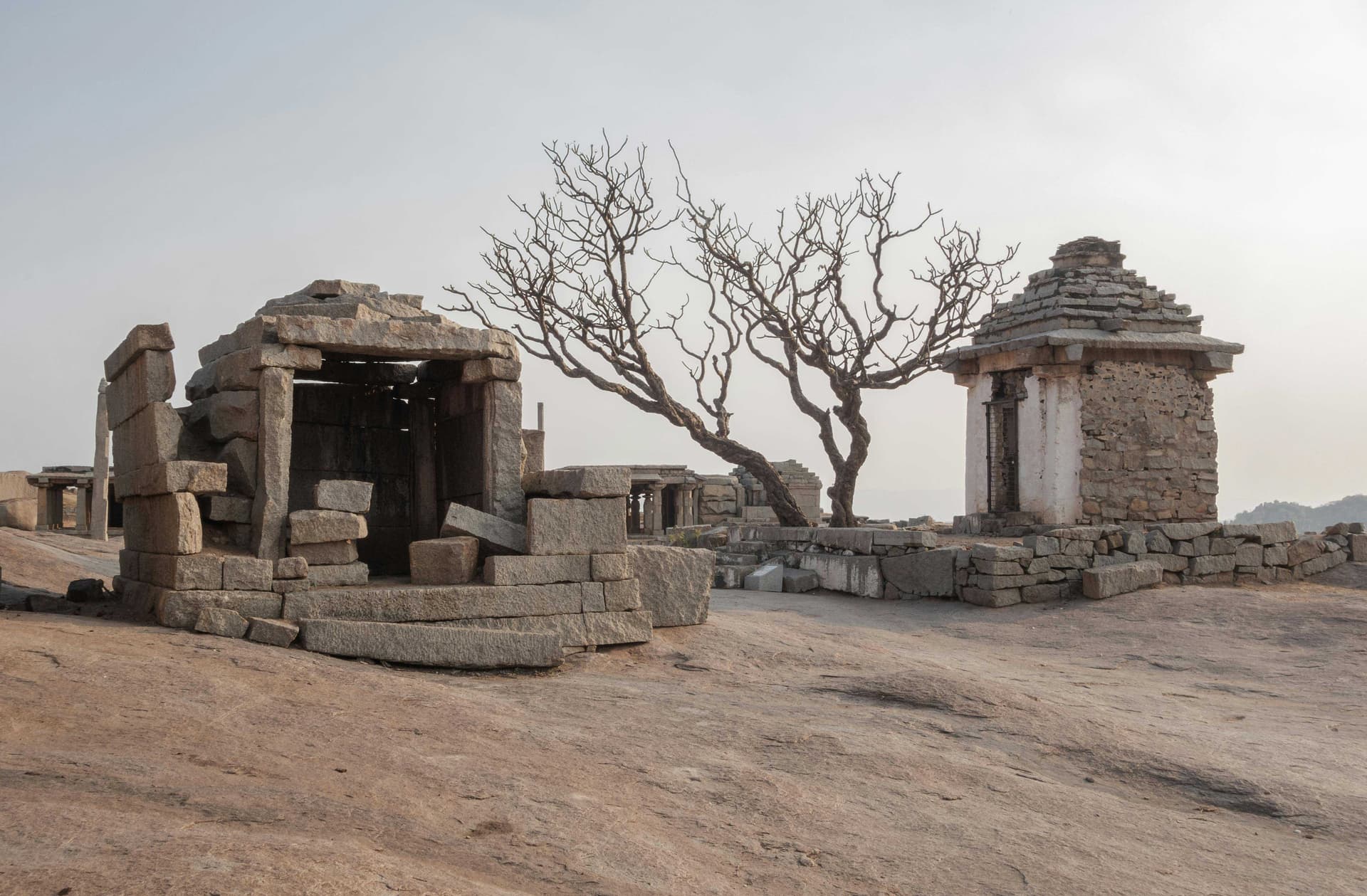
Hampi was designated a UNESCO World Heritage Site in 1986 under the title Group of Monuments at Hampi. It encompasses over 1,600 surviving monuments spread across approximately 41 square kilometers, representing one of the largest open-air archaeological complexes in the world.