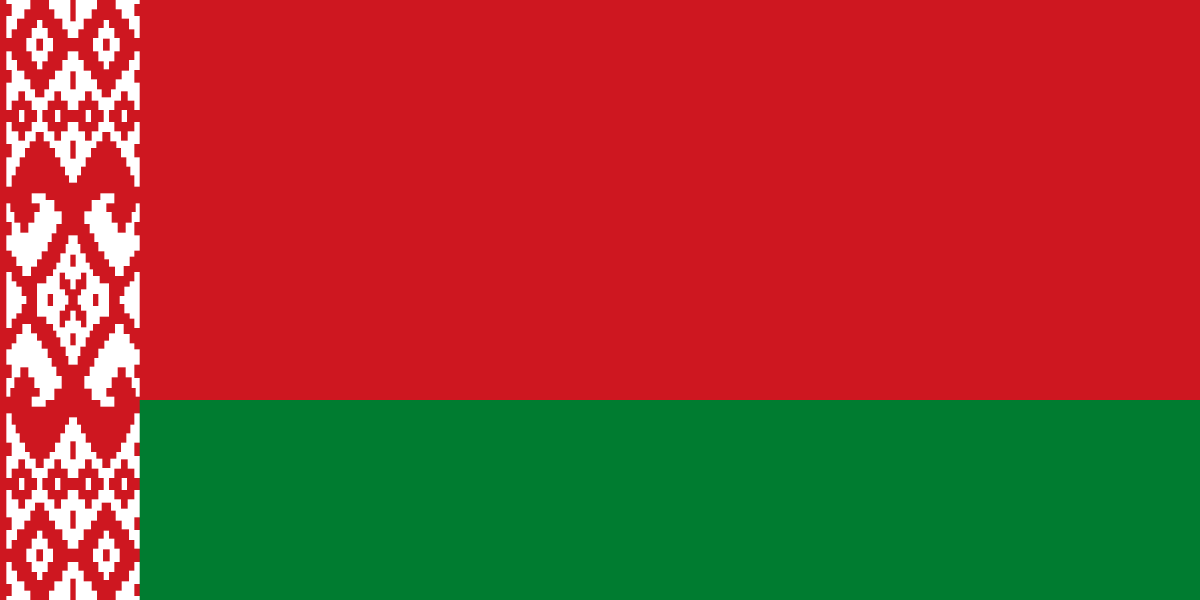
Belarus, officially the Republic of Belarus, is a landlocked country in Eastern Europe, bordered by Russia to the northeast, Ukraine to the south, Poland to the west, and Lithuania and Latvia to the northwest. Its history is rich and complex, shaped by its geographic location at the crossroads of Europe. Below is a detailed history of Belarus, highlighting significant events, historical figures, and landmarks.
Early History
-
Early Settlements and Kievan Rus': The area now known as Belarus was originally settled by Baltic and Slavic tribes. By the 9th century, these lands were part of the Kievan Rus', a federation of Slavic tribes under the leadership of the Varangians.
-
Grand Duchy of Lithuania (13th-16th centuries): As the Kievan Rus' declined, Belarusian lands were incorporated into the Grand Duchy of Lithuania. This period saw the flourishing of local culture and the adoption of the Ruthenian language as the state language.
Polish-Lithuanian Commonwealth and Russian Empire
-
Union with Poland (1569): The Polish-Lithuanian Commonwealth was formed in 1569, creating a dual state that lasted until the late 18th century. Belarusian territories were part of this union, which allowed for some degree of religious and cultural autonomy.
-
Partitions of Poland (1772, 1793, 1795): The partitions of Poland resulted in Belarusian lands being absorbed by the Russian Empire. This initiated a period of Russification and suppression of local culture and language.
20th Century Turmoil
-
World War I and the Russian Revolution (1917): The region was heavily impacted by World War I and the subsequent Russian Revolution. In 1918, Belarus declared independence as the Belarusian People's Republic, though it was short-lived.
-
Soviet Era (1922-1991): Belarus became a founding member of the Soviet Union as the Byelorussian Soviet Socialist Republic. During World War II, Belarus was a major battleground, suffering extensive destruction and loss of life.
-
Chernobyl Disaster (1986): The Chernobyl nuclear disaster in neighboring Ukraine severely affected Belarus, contaminating large areas of land and leading to long-term health impacts.
Independence and Modern Era
-
Independence (1991): Following the dissolution of the Soviet Union in 1991, Belarus declared its independence. Alexander Lukashenko became the first and, as of 2023, the only president since 1994, known for his authoritarian rule.
-
Political Protests (2020): The 2020 presidential election, widely criticized as fraudulent, sparked massive protests across the country. The government responded with a harsh crackdown on dissent.
Historical Figures
-
Francysk Skaryna (c. 1486-1541): A Belarusian scholar and one of the first book printers in Eastern Europe, Skaryna is celebrated for his efforts to publish the Bible in the Old Belarusian language.
-
Tadeusz Kościuszko (1746-1817): A military engineer and a leader in the Polish-Lithuanian Commonwealth, Kościuszko is remembered for his role in the American Revolutionary War and the Kościuszko Uprising against Russian influence.
Important Landmarks
-
Minsk: The capital city, known for its Soviet-era architecture and as the political and cultural center of Belarus.
-
Mir Castle Complex: A UNESCO World Heritage Site, this 16th-century fortress is a stunning example of Renaissance architecture.
-
Nesvizh Castle: Another UNESCO World Heritage Site, known for its beautiful baroque architecture and as a former residence of the Radziwiłł family.
-
Białowieża Forest: A UNESCO World Heritage Site shared with Poland, it is the last and largest remaining part of the primeval forest that once covered much of Europe.
-
Brest Hero-Fortress: A key symbol of Soviet resistance during World War II, known for its defense against the Nazi invasion.
Belarus has a rich tapestry of history, interwoven with periods of foreign domination and cultural resilience, and continues to navigate its path as an independent nation in the modern world.