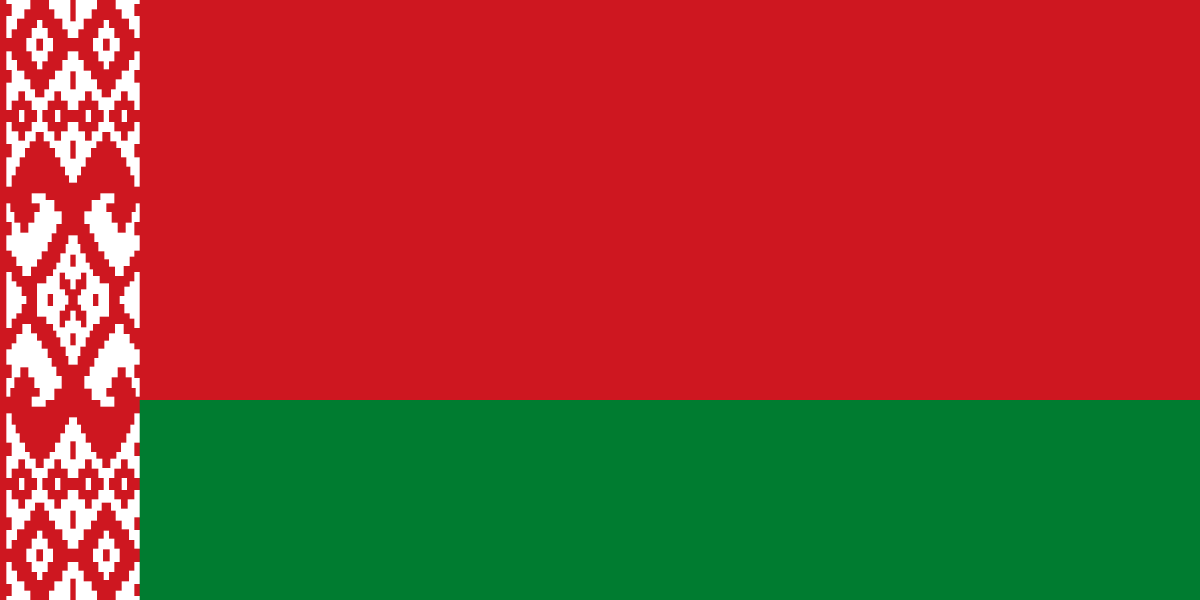
Uzda, located in the Minsk Region of Belarus, has a history that reflects the broader historical developments of the region. Here is a detailed overview:
-
Early History and Establishment:
- Uzda is first mentioned in historical records in the 15th century. At this time, the area was part of the Grand Duchy of Lithuania, which later formed a union with the Kingdom of Poland, creating the Polish-Lithuanian Commonwealth.
-
Polish-Lithuanian Commonwealth:
- During the Commonwealth period, Uzda was a private town owned by various noble families. The Radziwiłł family, one of the most powerful and influential families in the region, had significant influence over the area.
-
Partitions of Poland:
- In the late 18th century, the partitions of Poland led to the division of its territories among Russia, Prussia, and Austria. Uzda became part of the Russian Empire following the Second Partition in 1793.
-
19th Century Developments:
- Under Russian rule, Uzda was part of the Minsk Governorate. The town experienced the typical rural development patterns of the era, with agriculture being the primary economic activity.
- The construction of railways in nearby areas in the late 19th century helped develop the region economically, although Uzda itself remained more rural.
-
20th Century Turmoil:
- During World War I and the subsequent Russian Civil War, Uzda saw significant turmoil, as did much of Belarus.
- In the interwar period, following the Treaty of Riga in 1921, Uzda became part of the Byelorussian Soviet Socialist Republic within the Soviet Union.
-
World War II:
- During World War II, Uzda was occupied by Nazi Germany from 1941 to 1944. The town witnessed atrocities, including the persecution of its Jewish population, which was a significant part of the local community before the war.
-
Post-War Period and Soviet Era:
- After the war, Uzda was rebuilt and continued to develop as part of the Soviet Union. The establishment of collective farms (kolkhozes) and industrial enterprises shaped its economy.
-
Modern Era:
- With the dissolution of the Soviet Union in 1991, Uzda became part of the newly independent Republic of Belarus.
- Today, Uzda is a small town known for its local industries, cultural heritage, and historical sites.
-
Landmarks and Cultural Heritage:
- Notable landmarks in and around Uzda include various religious and historical buildings, such as Orthodox and Catholic churches, reflecting the town's cultural diversity.
- The town's history is also preserved in local museums and cultural institutions that document the region's past.
While Uzda may not be widely known for specific historical figures, its history is emblematic of the broader historical currents that have shaped Belarus and Eastern Europe.
Information not available.