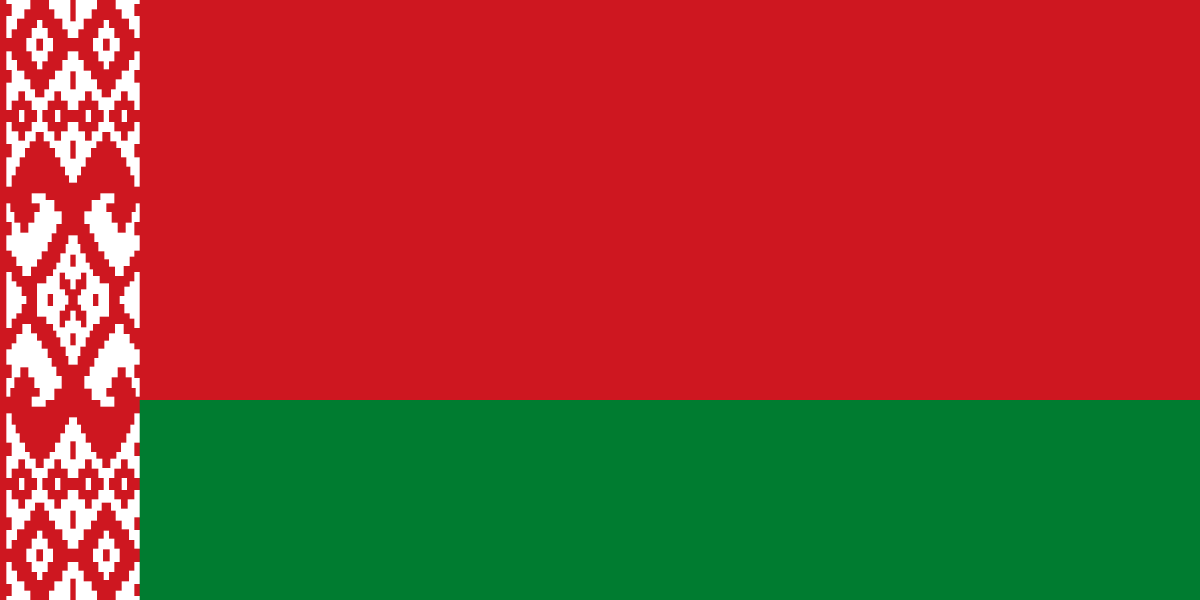
Haradok is a town located in the Vitsyebskaya Voblasts' (Vitebsk Region) of Belarus. Its history is intertwined with the broader historical narratives of the region, particularly those of the Grand Duchy of Lithuania, the Polish-Lithuanian Commonwealth, and the Russian Empire.
Early History
- First Mention: Haradok was first mentioned in historical records in the 16th century. The exact date of its founding is not clear, but it was likely established as a small settlement in the medieval period.
Polish-Lithuanian Commonwealth
- Union of Lublin (1569): Haradok became part of the Polish-Lithuanian Commonwealth following the Union of Lublin. During this period, the town was under the influence of Polish and Lithuanian nobility.
Russian Empire
- Partitions of Poland (1772-1795): As a result of the partitions of Poland, Haradok was annexed by the Russian Empire. This changed the administrative and cultural landscape of the town, as it became part of the Russian imperial territories.
19th Century
- Economic Development: The 19th century saw gradual economic development in Haradok, particularly with the expansion of trade routes and the influence of industrialization in the Russian Empire.
20th Century
- World War I and II: Haradok, like much of Belarus, was significantly affected by both World Wars. The town experienced occupation and was a site of military engagements.
- Soviet Period: After the Russian Revolution, Haradok became part of the Byelorussian Soviet Socialist Republic. During this period, the town underwent Sovietization, which included changes in administrative structures, education, and economy.
Post-Soviet Period
- Independence of Belarus (1991): With the dissolution of the Soviet Union, Haradok became part of the newly independent Republic of Belarus. The town has since been developing within the framework of Belarusian national policies.
Significant Landmarks and Cultural Heritage
- Local Churches and Architecture: Haradok hosts several religious and historic buildings that reflect its diverse past. These include Orthodox and Catholic churches, which are significant for their architectural styles and historical value.
- Natural Landscapes: The surrounding natural beauty of the Vitebsk region adds to the town's appeal, with forests and rivers providing recreational opportunities.
Modern Haradok
Today, Haradok is a small town that reflects the historical influences of its past while serving as a local administrative and cultural center. It continues to develop, balancing modernity with the preservation of its historical and cultural heritage.
Information not available.