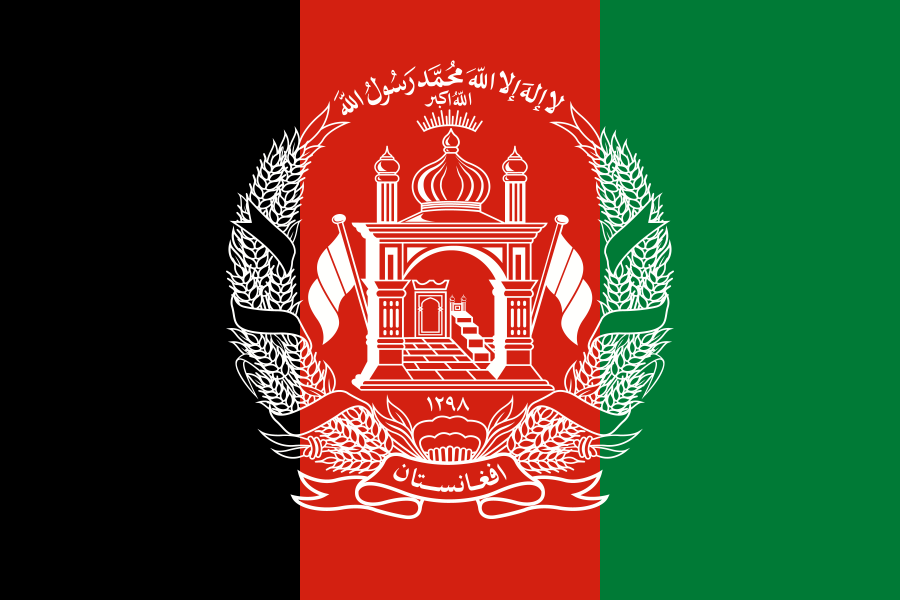
Afghanistan
· AF

Afghanistan

Afghanistan

Afghanistan: A Land of Timeless Beauty and Untamed Spirit (Please note: Due to the current political climate and safety concerns, travel to Afghanistan is not recommended at this time. This response is for informational …

#Central Asia#War-torn country#Mountainous terrain#Islamic culture#Kabul
1/13

Top hotels & flights

Hand-picked stays and the best fares into Afghanistan.

Top Hotels in Kabul

Top Flights to Kabul

Popular activities

Tours, tickets and experiences travelers book most in Afghanistan.

Tours

Kabul City Tour

Explore the rich history and culture of Afghanistan's capital city.

Shopping

Shopping in Kabul's Markets

Browse and shop for unique Afghan carpets and handicrafts.

Outdoor

Adventure in the Wakhan Corridor

Experience the rugged landscapes and natural beauty of Afghanistan's mountains.

Location videos

Real reels from travelers, plus longer watches to get the full picture.

From travelers
Watch & explore

Practical info

The essentials for planning your time in Afghanistan.

Currency
؋ | AFN | Afghan Afghani
Population
40.2 million
Languages
Pashto, Dari, Uzbek, Turkmen, Pashto, Nuristani, Baluchi, Pashai
Average weather
Afghanistan
Jan
cold
7°-5°
Feb
cold
9°-3°
Mar
cloud
15°2°
Apr
clear
21°8°
May
sun
27°13°
Jun
hot
33°17°
Jul
hot
36°19°
Aug
hot
35°18°
Sep
clear
30°13°
Oct
clear
23°7°
Nov
cloud
15°2°
Dec
cold
9°-3°

Local guide

What travelers love, what to watch for, and a deeper read on Afghanistan.

What people love

Traveling to Afghanistan can offer a unique and immersive experience for those interested in history, culture, and adventure. Here are some potential pros of traveling to Afghanistan:

  1. Rich History: Afghanistan is home to ancient civilizations, including the famous Silk Road, Buddhist relics, and Islamic architecture. Visitors can explore historical sites such as the Minaret of Jam, the Buddhas of Bamiyan, and the old city of Herat.

  2. Cultural Diversity: Afghanistan is a melting pot of different ethnicities, languages, and traditions. Travelers can experience diverse cultures, taste local cuisines, and interact with friendly locals.

  3. Scenic Landscapes: Afghanistan boasts stunning natural beauty, from snow-capped mountains and lush valleys to deserts and lakes. Outdoor enthusiasts can enjoy activities like trekking, skiing, and wildlife spotting.

  4. Hospitality: Afghan people are known for their hospitality and warmth towards guests. Travelers may have the opportunity to stay in traditional guesthouses, share meals with families, and engage in cultural exchanges.

  5. Unique Souvenirs: Afghanistan is famous for its handicrafts such as carpets, jewelry, pottery, and textiles. Visitors can purchase authentic souvenirs and support local artisans.

Please note that traveling to Afghanistan may present challenges, including security concerns, political instability, and limited tourist infrastructure. It is important to research thoroughly, follow travel advisories, and take necessary precautions before planning a trip to Afghanistan.

If you have specific questions or need further information, feel free to ask!

What to know

Traveling to Afghanistan can be risky due to the ongoing political instability, frequent terrorist attacks, and high levels of violence in certain regions. The country has also experienced natural disasters such as earthquakes and avalanches. The security situation is unpredictable, and there is a high threat of kidnapping, armed conflict, and attacks targeting foreigners.

Additionally, access to healthcare services can be limited, and the quality of medical facilities may not meet international standards. Road infrastructure is poor, and travel within the country can be challenging and dangerous due to the presence of landmines and armed groups.

Cultural and religious practices may differ significantly from those in Western countries, and travelers are expected to respect local customs and traditions. Women, in particular, may face restrictions on their behavior and dress in certain areas.

Please note that the situation in Afghanistan is constantly evolving, and travelers are advised to stay informed about the latest developments and consult with their government's travel advisory before planning a trip to the country.

Afghanistan has a rich and complex history, shaped by its strategic location at the crossroads of Central and South Asia. Here's a detailed overview of its history, significant events, historical figures, and important landmarks:

Ancient and Medieval Periods

  • Indus Valley Civilization (c. 3300–1300 BCE): The region was part of the ancient Indus Valley Civilization.
  • Achaemenid Empire (c. 550–330 BCE): Afghanistan was incorporated into the Persian Empire under Cyrus the Great.
  • Alexander the Great (330 BCE): The area was conquered by Alexander the Great, who founded the city of Alexandria Arachosia (modern Kandahar).
  • Mauryan Empire (c. 322–185 BCE): After Alexander, the region became part of the Mauryan Empire under Ashoka, who promoted Buddhism.
  • Kushan Empire (c. 1st–3rd century CE): This empire facilitated the spread of Buddhism and trade along the Silk Road.
  • Islamic Conquest (7th century): The arrival of Islam began with the Arab conquests, leading to the region's gradual Islamization.
  • Ghaznavid Empire (977–1186): Founded by Mahmud of Ghazni, this empire was known for its military campaigns in the Indian subcontinent.
  • Ghorid Dynasty (12th century): Notable for expanding into India, the Ghorids established the Delhi Sultanate.

Early Modern Period

  • Mughal Empire (16th–17th century): Parts of Afghanistan were incorporated into the Mughal Empire, although local rulers retained significant power.
  • Safavid Empire (1501–1736): Western Afghanistan was often contested between the Safavids and various Afghan tribes.

18th and 19th Centuries

  • Hotak Dynasty (1709–1738): Established by Mirwais Hotak in Kandahar, it was a short-lived but significant Afghan dynasty.
  • Durrani Empire (1747–1823): Founded by Ahmad Shah Durrani, considered the founder of modern Afghanistan. The empire expanded significantly under his rule.
  • Anglo-Afghan Wars: Afghanistan was the focus of British and Russian rivalry during the "Great Game." Three major wars occurred:
    • First Anglo-Afghan War (1839–1842): Resulted in a disastrous retreat for the British.
    • Second Anglo-Afghan War (1878–1880): Led to British control of Afghan foreign affairs but maintained internal autonomy.
    • Third Anglo-Afghan War (1919): Led to Afghanistan regaining full independence.

20th Century

  • Kingdom of Afghanistan (1926–1973): Modernization efforts were seen under King Amanullah Khan, who sought to modernize Afghanistan but faced resistance.
  • Republic of Afghanistan (1973–1978): A coup led by Mohammed Daoud Khan ended the monarchy, establishing a republic.
  • Saur Revolution (1978): The communist People's Democratic Party of Afghanistan took power, leading to instability.
  • Soviet-Afghan War (1979–1989): The Soviet Union invaded to support the communist government, sparking a decade-long conflict.
  • Rise of the Mujahideen: Various factions, supported by the US, Pakistan, and others, fought against Soviet forces, leading to their withdrawal in 1989.

Late 20th and Early 21st Centuries

  • Civil War (1992–1996): After the Soviet withdrawal, infighting among Mujahideen factions led to a civil war.
  • Taliban Regime (1996–2001): The Taliban, an Islamist militant group, gained control, implementing a strict interpretation of Sharia law.
  • US Invasion (2001): Following the 9/11 attacks, the US-led coalition ousted the Taliban for harboring al-Qaeda.
  • Islamic Republic of Afghanistan (2004–2021): A new constitution was established, leading to democratic elections.
  • Taliban Resurgence (2021): The US withdrawal led to a rapid Taliban takeover, re-establishing their control over Afghanistan.

Important Historical Figures

  • Ahmad Shah Durrani: Founder of the Durrani Empire.
  • Abdur Rahman Khan: Known as the "Iron Amir," he consolidated power and modernized the state.
  • Amanullah Khan: Modernizing king who declared Afghanistan's independence.
  • Hamid Karzai: First democratically elected president post-Taliban.

Important Landmarks

  • Bamiyan Buddhas: Giant Buddha statues destroyed by the Taliban in 2001.
  • Herat Citadel: A historical fortress dating back to Alexander the Great.
  • Minaret of Jam: A UNESCO World Heritage site from the Ghorid period.
  • Blue Mosque (Mazar-i-Sharif): A significant pilgrimage site in northern Afghanistan.

Afghanistan's history is marked by a series of invasions, empires, and conflicts, each leaving its mark on the country's cultural and political landscape.